
St Monica’s Catholic Primary School, Hoxton
Music Curriculum Plan (Charanga-Based)
Intent
At St Monica’s, music plays a vital role in developing creativity, confidence, and a sense of community. Through the Charanga music scheme, pupils engage in a rich and structured programme that nurtures their musical understanding, appreciation, and performance skills. Our curriculum reflects our Catholic ethos by celebrating joy, collaboration, and respect for diverse musical traditions.
Implementation
All lessons follow the Charanga model, providing a balanced approach through listening, performing, composing, and appraising. Each unit follows a consistent structure to develop pupils’ musical knowledge and progression over time.
Typical Lesson Sequence
1. Listen and Appraise
o Pupils listen to a range of musical styles and genres.
o They identify instruments, tempo, dynamics, and mood.
o Discussion links are made to cultural, historical, and religious contexts.
2. Warm-up Games
o Focused on rhythm, pitch, and pulse awareness.
o Activities develop coordination, vocal control, and focus.
3. Flexible Games Track
o Interactive rhythm and pitch games using Charanga’s digital tracks.
o Reinforces notation, timing, and group participation.
4. Learn to Sing the Song
o Songs are taught progressively with attention to breathing, diction, and expression.
o Emphasis on enjoyment, teamwork, and musical phrasing.
5. Play Your Instruments
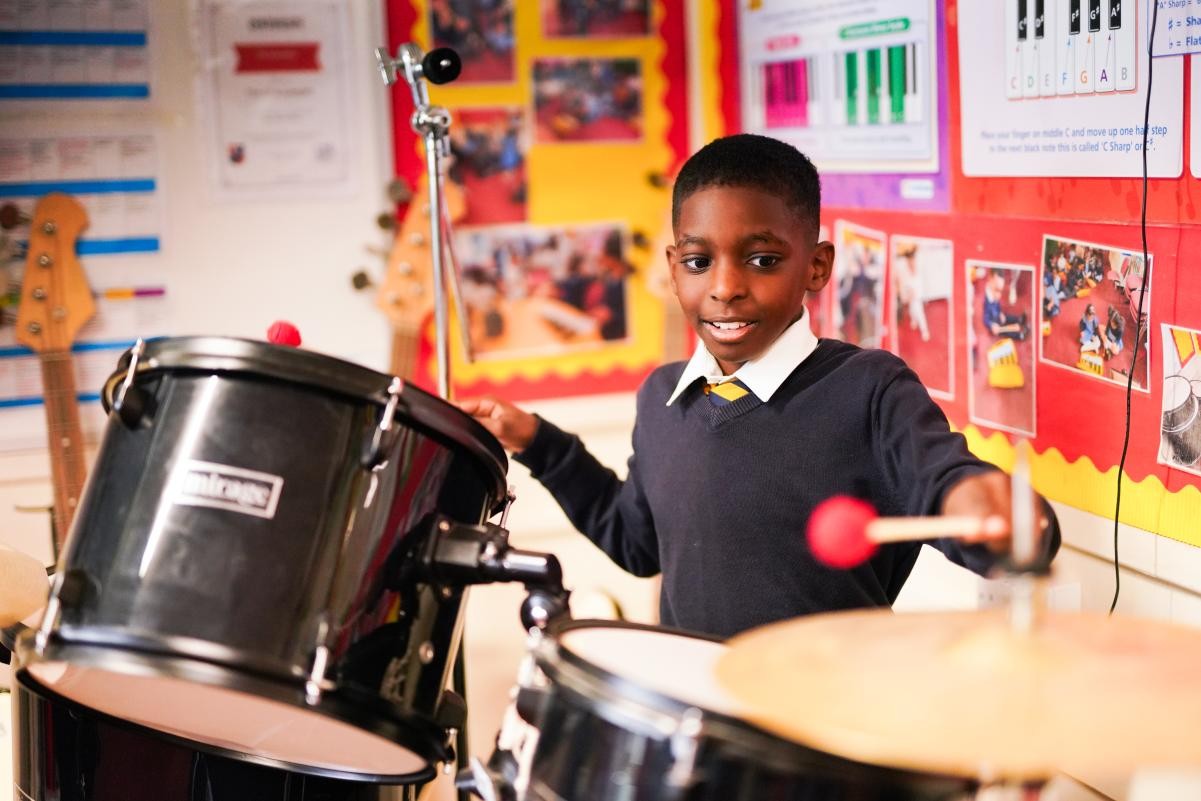
o Pupils play tuned and untuned percussion, recorders, or glockenspiels.
o They follow notation and contribute to ensemble performances.
6. Improvise with the Song
o Children explore short improvisations using the notes of the song.
o Encourages creativity and listening to others.
7. Extended Improvisation
o Pupils perform longer improvisations, using Charanga backing tracks.
o Develops confidence, fluency, and expression.
8. Compose with the Song
o Children create their own short compositions based on the song’s melody or rhythm.
o They notate and perform their work for peers.
9. Perform the Song
o The unit culminates in a performance that integrates singing, instruments, and movement.
o Performances may take place in assemblies, Masses, or school celebrations.
Impact
· Pupils develop a secure understanding of musical elements (pulse, rhythm, pitch, dynamics, tempo, structure, and notation).
· They gain confidence as singers, performers, and composers.
· They demonstrate respect and appreciation for different musical styles and traditions.
· Music contributes to pupils’ spiritual, moral, and cultural development, reinforcing the Catholic values of joy, participation, and community